
How to Lower Your Price on Vinted and Wallapop to Sell More
Listing an item on Vinted or Wallapop and waiting for it to sell itself is a strategy that works for the first two or three days. After that, the listing sinks in the feed and buyers don’t even see it. It’s not that they’re not interested. It’s that they never get to it.
The mistake most people make is to do nothing: keep the same price, leave everything as is and wait for something to change. But the algorithms of both platforms penalise inactivity and reward listings that generate movement. Knowing when to lower the price, by how much and how to do it makes the difference between a listing that sells in ten days and one that has been gathering digital dust for three months.
This isn’t about selling below value. It’s about managing your price intelligently to maximise what you receive without leaving money on the table.

Why listings die over time (and what the algorithm does with them)
Every listing has a life cycle. The first day is the best: the algorithm treats it as new content and gives it visibility in the feed. From the second or third day onwards, that advantage disappears and the listing starts competing at a disadvantage against the ones just published.
On Wallapop this is especially clear: the platform officially states that the publication date is the first positioning factor. Newer listings appear before older ones, without exception.
On Vinted the mechanism is slightly different but the result is similar. The platform also takes the age of the listing into account and prioritises those that generate recent activity: saves, views and conversations. A listing with no interactions for days drops progressively in search results.
A stagnant price is a signal of an abandoned listing. It’s not enough for the item to be well photographed and well described: if the price never moves and the listing generates no activity, the system reads it as content of no interest and buries it.
The diagnosis before acting matters, though. Each symptom has its solution:
Lots of views and few saves: the price is probably fine, but the photos or title aren’t convincing. A price drop alone won’t solve this.
Lots of saves but few or no offers: the item is of interest but the price is blocking the decision. A moderate drop or a private offer to wishlist savers usually does the trick.
Few views and no saves: the problem is visibility. Tweak the title, improve the keywords and, on Wallapop, relist to return to the top of the feed.
Vinted's notifications system: your secret weapon
Vinted has a feature that few sellers use well: when you drop the price of an item, the platform automatically sends a notification to all users who have it in their wishlist. You don’t have to do anything else. They receive the alert, remember they were interested and many end up buying.
This turns every save into a latent sales opportunity. The buyer who saved your item had already shown intent: they just needed the right nudge.
There is an important technical condition: the drop needs to be at least 10% of the current price for the notification to be triggered. If you drop from €20 to €19.50, nobody gets an alert. If you drop from €20 to €17 or less, the notification is sent. This 10% threshold is the minimum for the system to consider it a relevant reduction.
There is also another complementary mechanism that works differently: the private offer to wishlist savers. From the listing itself you can send a personalised offer to people who have it saved without lowering the public price of the item. The advantage is that the listing price doesn’t change for other buyers, only for that group. The recommended range is a 10% to 20% discount on the current price, this is the range that converts best without making the buyer feel they’re buying something that has lost value.
One thing to bear in mind: when you lower the price on Vinted, that new price becomes visible to all buyers, not just those who have it saved. If you’re thinking of raising the price afterwards, Vinted doesn’t send a notification when the price goes up, only when it goes down. That’s an advantage: you can raise the price without disturbing anyone and without algorithmic penalty.
The strategy to lower prices step by step
The key to a good devaluation is that it’s gradual and that each drop has a purpose: either to trigger Vinted’s notifications, return to Wallapop’s feed, or simply adjust the price to real demand. What doesn’t work is dropping immediately on day one out of impatience, or staying still for weeks waiting for something to happen.
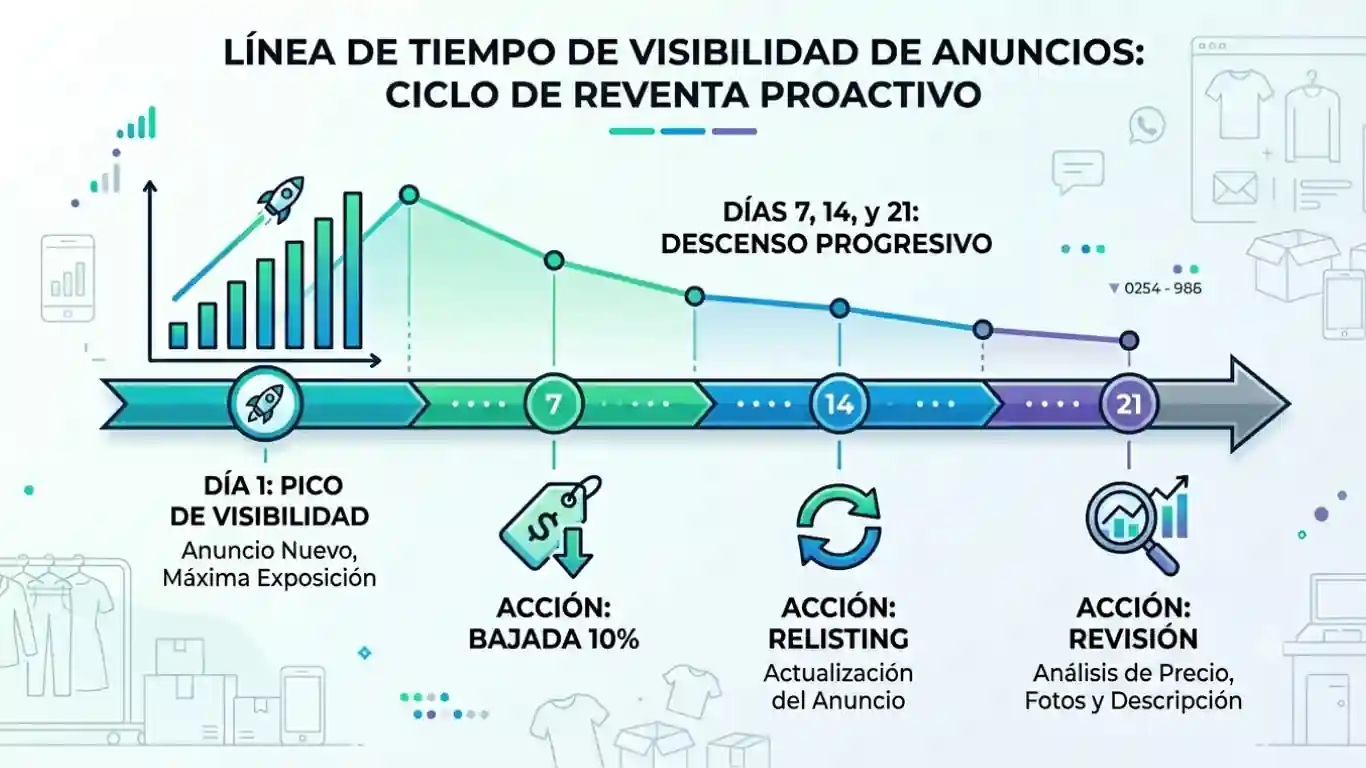
This is the calendar that works best for a standard item:
1) Days 1 to 5: starting price with margin. Always list with a price slightly above the minimum you’d accept. A margin of 10-15% is enough. This gives you room to negotiate and for the first drop without losing what you wanted to earn.
2) Day 7: first review. If you have saves but no offers, trigger the notification by dropping 10% of the current price. If you have few saves and few views, the problem is visibility: review the title and keywords before touching the price.
3) Day 14: second review. If the first drop didn’t generate sales, drop another 10%. On Wallapop, this is the moment to consider whether to relist instead of just dropping (I’ll explain this in the next section).
4) Day 21: the bottom-line decision. If the item has gone three weeks without selling after two drops, it’s time to decide: drop to the minimum price you’ll accept, relist with revised photos and description, or withdraw it temporarily and republish later when seasonal demand picks up.
*A tip: set your minimum price before you list, not when you’ve already been negotiating for weeks. Deciding in cold blood what the least you’ll accept avoids impulsive drops that end in sales you’re not happy with.
The logic differs between Vinted and Wallapop at one key point: on Vinted a price drop triggers notifications, so each drop needs to be at least 10% to count. On Wallapop notifications to wishlist savers don’t work the same way, so the main lever isn’t the price but the publication date, which resets when you relist. On Wallapop you can drop the price and relist at the same time to combine both effects.

How to manage prices when you have lots of items
Applying this strategy with five items is one thing. With fifty it’s another. When inventory grows, manual tracking becomes unworkable: you can’t remember when you listed each item, which one has had no interactions for two weeks and which one already had a price drop last week.
The usual result is that the most recent items get all the attention and the older ones stay there indefinitely, accumulating days without views while nobody does anything about it. The inventory stagnates and so do the earnings.
This is exactly the problem that EasyWList’s visual inventory solves. The tool lets you mark each item as “In inventory”, “Listed” or “Sold”, giving you a clear at-a-glance view of what’s active, what has sold and what has been sitting too long without moving. With the entire catalogue organised in one place, it’s much easier to spot the items that have been listed the longest and act on them before the algorithm buries them completely.
And because EasyWList manages listings on both Vinted and Wallapop from a single interface, when you decide to relist an item on Wallapop or adjust the price on Vinted you don’t have to hunt for photos or rewrite the description from scratch: the tool already has all that information saved and the whole process takes under two minutes.
Frequently asked questions about lowering prices on Vinted and Wallapop
How much do I need to drop the price on Vinted for wishlist savers to receive a notification?
−The drop needs to be at least 10% of the current price for Vinted to send the automatic notification. If you drop less than that percentage, the system doesn't consider it a relevant change and nobody receives any alert. For example, on a €20 item you need to drop to at least €18 to trigger it.
Is it better to lower the price gradually or all at once?
+Gradually is almost always the better option, for two reasons. First, each 10% drop on Vinted generates a new notification, so several moderate drops create several moments of attention. Second, a drastic price drop all at once can signal to the buyer that something is wrong with the item, which creates distrust rather than urgency.
Is there a minimum price below which selling isn't worth it?
+It depends on each item and your shipping costs, but a useful benchmark is to check whether what you receive after shipping costs and platform commissions covers at least the cost of packaging and the trip to the post office. Below €3-4 net margin, in many cases it's more worthwhile to donate the item than to manage it as a sale. Set your minimum price before listing, not when you're already deep in a negotiation.
Stop waiting and start moving your inventory
Lowering your price strategically isn’t giving up or selling below value: it’s actively managing your catalogue so every item reaches the right buyer at the right time. A price that drops intelligently generates more total income than one that stays rigid until the item expires.
The real problem isn’t knowing what to do. It’s having the time and organisation to do it when you have lots of items on two platforms at once. Reviewing which ones have had no interactions for a week, which have already had a price drop, which deserve a relisting on Wallapop and which simply need to be withdrawn: doing it all by hand, listing by listing, ends up consuming more time than it deserves.
EasyWList gives you the visual control you need to manage your inventory without losing your mind. From a single screen you can see which items have been active the longest, which ones have sold and which are still waiting. When you decide to act on one of them, the tool has the photos, title and description already saved, and puts it live on Wallapop in under 30 seconds. No searching for files, no rewriting anything, no wasting time you should be investing in finding the next sell faster.
EasyWList’s beta is free right now. Those who adopt it at this stage will have exclusive advantages when the final version launches.